


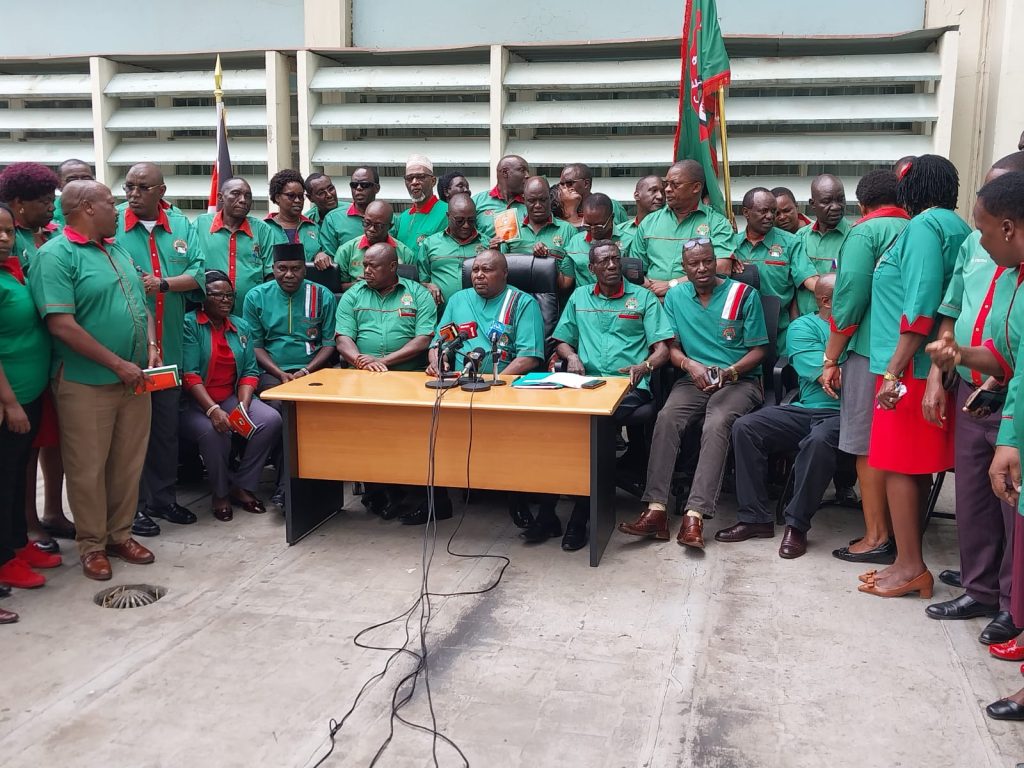
The Kenya National Union of Teachers (KNUT) has moved to close out the final chapter of its 2026 leadership renewal exercise, with branches across the country now spearheading elections for School KNUT Representatives.
The directive follows a circular issued by KNUT Secretary General Collins Oyuu, instructing all branches to conclude the elections by September 30, marking the last elective post yet to be filled in the union’s current electoral cycle.
School KNUT Representatives serve as the union’s frontline contact persons within individual learning institutions, linking teachers at the grassroots to branch and national leadership.
Their election had remained outstanding even as the union completed the rest of its leadership renewal earlier in the year, and Oyuu’s circular now places the responsibility squarely on branch officials led by Branch Secretaries to organize, supervise, and finalize these polls within the stipulated timeline.
A Leadership Cycle Concluded in April
The push to fill the School Representative positions comes on the back of a broader and more consequential exercise that unfolded till April this year, when KNUT conducted elections across all levels of its leadership structure.
The polls covered positions ranging from the grassroots level — including Branch Executive Committee (BEC) members and Woman Representatives — up to the union’s top national offices of Secretary General and National Chairman.
It was during this exercise that Collins Oyuu was re-elected unopposed as KNUT Secretary General on April 3, 2026, at Tom Mboya Labour College in Kisumu.
His re-election, alongside that of other national and branch officials, ushers in a new five-year term of office running from 2026 to 2031.
With the top leadership positions and branch structures now settled, the School Representative elections represent the final piece needed to complete the union’s full leadership architecture for the new term.
Only Paid-Up Members May Vote
As branches roll out these elections, KNUT has been keen to remind teachers that participation is strictly reserved for union members.
This has proved a sticking point for some teachers whose payslips do not reflect KNUT deductions as “Union Dues” but instead show “Agency Fees” — an indication that, despite having dues deducted, they are not formally registered members of the union and therefore do not qualify to vote or be elected.
To address this, KNUT has issued a clear procedure allowing such teachers to convert their status and register as full members ahead of the elections.
The union has explained the distinction between the two categories: Agency Fees are paid by a teacher who is not a KNUT member but still benefits from the Collective Bargaining Agreement (CBA) that the union negotiates on behalf of all teachers, while Union Dues are paid by teachers who are registered, card-carrying members of KNUT.
Both categories are charged at the same rate — 2 percent of a teacher’s basic pay — meaning the shift from agency fee payer to full member does not change what is deducted from a teacher’s salary, only their membership status and the rights that come with it.
Steps to Register as a KNUT Member
For teachers seeking to change their status from Agency Fees to Union Dues and gain voting rights, KNUT has outlined the following procedure through the T-Pay platform:
- Log in to your T-Pay account at https://tpay.tsc.go.ke.
- Under the menu bar, click on “Send Payslips.”
- Select “SWA.”
- Choose “KNUT – Union Dues.”
- Click on “Send OTP.”
- Wait for a One-Time Password (OTP) to be sent to your phone.
- Enter the OTP to proceed.
- A confirmation message will appear reading: “Payslip sent to KNUT Union Dues.”
Once this step is approved, a teacher’s payslip status changes from “Agency Fees” to “Union Dues,” officially confirming membership.
Teachers are further required to share their TSC Number and phone contact with KNUT Headquarters for capturing into the union’s membership database.
This can be done through the Executive Officer, Mark Oseno, reachable on 0726 979198, or the ICT Officer, Peter Rotich, on 0722 781045.
The final step involves member approval on the TSC Online Payslip portal. Teachers are advised to log in, click on “My Transaction,” then “Approve Transaction,” followed by “Approve Loan” to finalize the approval process.
Only once this full process is completed will a teacher be recognized as an eligible, voting member of KNUT — a status now required for participation in the ongoing School Representative elections.
A Term Defined by Early Wins
Since his re-election in April, Collins Oyuu has been widely credited by sections of the teaching fraternity for delivering a string of tangible wins that have shaped the opening months of his new term.
Chief among these is a major victory secured on the medical insurance front, where sustained pressure from KNUT contributed to the government’s decision to abolish co-payment charges under the Social Health Authority (SHA) medical scheme — a levy that had drawn widespread complaints from teachers accessing treatment.
The breakthrough followed a marathon meeting held on April 22 in Mombasa, which brought together the Teachers Service Commission (TSC), SHA, the Kenya Union of Post Primary Education Teachers (KUPPET), and KNUT to iron out teachers’ pressing welfare concerns.
Beyond scrapping co-payments, the parties agreed to expand coverage for specialized treatment, raise outpatient capitation limits, and onboard more accredited health facilities into the scheme.
Oyuu is also credited with brokering a Memorandum of Understanding (MOU) with the Open University of Kenya, opening the door for serving teachers to pursue further studies at an affordable cost while remaining in active service.
On the promotions front, his engagements with TSC yielded another notable concession: P1 teachers deployed to junior schools who had served only two years in their current grade were allowed to apply for ongoing promotions, despite the Career Progression Guidelines (CPG) ordinarily requiring a minimum of three years of service before eligibility.
TSC’s decision to lower this threshold to two years opened the door for affected teachers to apply for the 34,016 promotion vacancies currently advertised, with the commission even readvertising some positions to accommodate them.
Perhaps most significant for long-term teacher welfare is Oyuu’s role in pushing TSC toward abolishing the 2018 CPG framework, which teachers have long blamed for career stagnation due to its lengthy 30-year promotion timelines.
In its place, a new CPG has been developed and now is undergoing evaluation by the Salaries and Renumeration Commission (SRC) that would shorten the path to promotion to between 16 and 18 years of service.
Lingering Friction Over Sossion
Despite these gains, Oyuu has not escaped criticism. A section of teachers has taken issue with his silence following the recent swearing-in of former KNUT Secretary General Wilson Sossion as a Commissioner at the Teachers Service Commission.
Sossion, who previously led the union before Oyuu, has since assumed his new role at TSC, yet Oyuu is yet to publicly congratulate him.
Some teachers have publicly called on the current Secretary General to set aside any past differences with his predecessor and extend the customary goodwill message, arguing that such gestures matter for unity within the broader teaching fraternity, even amid divergent political and organizational histories between the two leaders.
As the September 30 deadline for School Representative elections approaches, branches now face the task of balancing this final electoral obligation with the wider expectations placed on Oyuu’s leadership to sustain the momentum of early wins into the rest of his five-year term.