


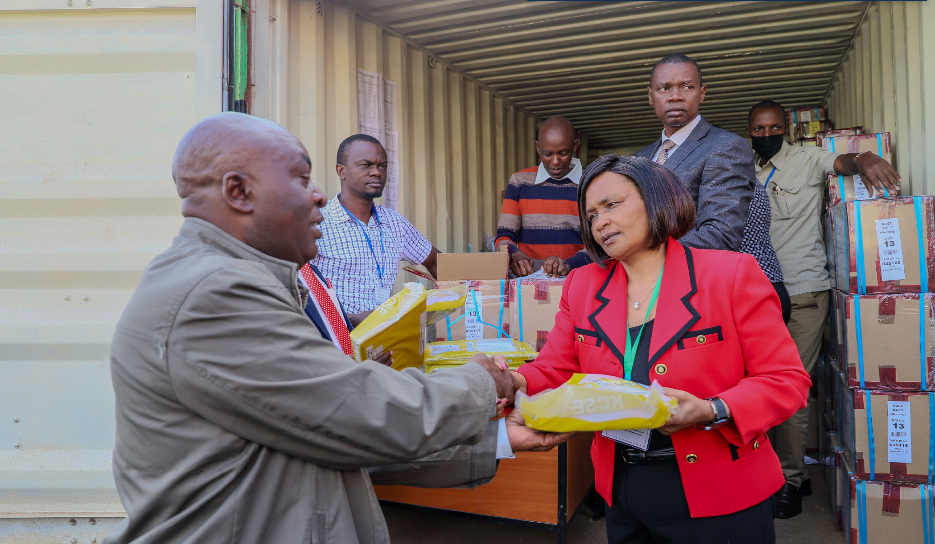
Packaging KPSEA and KJSEA Materials: A Practical Guide for Centre Managers, Supervisors and SCDEs
Every assessment ends with a packing exercise. Done correctly, it protects the work candidates have put in. Done carelessly, it creates delays, queries and lost scripts.
The 2026 Kenya Primary School Education Assessment (KPSEA) and Kenya Junior School Education Assessment (KJSEA) depend on materials moving cleanly from the examination room to the container and then to KNEC.
This article walks through what the KNEC guide requires, from carton colours to return labels.
Colour codes
KNEC uses colour coding so that materials for different assessments are never mixed. KPSEA cartons carry white labels with small pink stickers, while KJSEA cartons carry green labels.
Both use blue carton straps. SCDEs should store them separately in the container from the point of receipt.
Question paper polybags are light green for KPSEA and blue for KJSEA. Cover pages follow a code too.
KPSEA uses pink for Session 1 and blue for Session 2. KJSEA uses pink for Session 1, blue for Session 2 and green for Session 3.
The return envelopes follow the same logic. KPSEA script return envelopes are black. KJSEA script return envelopes are green.
An OMR set packed in the wrong colour has to be untangled later, usually by someone far from the centre.
Know the KJSEA paper format first
KPSEA is straightforward, since candidates answer on OMR sheets. KJSEA papers come in three formats, and each is packed differently.
Multiple Choice only. These are English Language (901/1), Kiswahili Lugha (902/1) and Kenya Sign Language Receptive Skills (904/1). They come with question papers and OMR sheets, with no perforation, and are packed like KPSEA.
Structured only. These are English Composition and Literary Analysis (901/2), Kiswahili Insha na Utangulizi wa Fasihi (902/2), KSL Language Use (904/2) and Integrated Science (905/2). There are no OMRs. The question papers are personalised and perforated, and candidates write on them, so the scripts are packed as answer scripts.
Mixed format. These are Mathematics, Integrated Science (905/1), Agriculture, Social Studies, Christian, Islamic and Hindu Religious Education, Creative Arts and Sports (Theory), and Pre-Technical Studies Theory. They have personalised, perforated question papers and OMR sheets. The question papers are handled as answer scripts, and the OMRs are handled as in KPSEA.
Supervisors should confirm the format of the day’s paper before packing begins, because it decides what goes where.
Packing OMR-based papers
This covers KPSEA and KJSEA MCQ-only papers. At the end of the session, the supervisor accounts for every script in the room, in front of the candidates and other witnesses. Materials then go to the Centre Manager in two groups.
The first group is the script return envelopes holding the OMR sheets. Each one must have a Return Cover Page with the barcode facing upward so it can be scanned. The guide states that every return envelope must have one.
The second group is the used question paper polybag(s). These hold all question papers, including unused ones and those for absent candidates, together with the Supervisor’s Instruction Sheet. The envelopes must be stapled.
Packing structured and mixed-format papers
For structured papers, and for the question paper portion of mixed-format papers, the script return envelope holds the answer scripts, the Return Cover Page with the barcode up, and a Script Control Form. Every envelope needs both documents.
The used question paper polybag holds three items:
- Sheet 1, the question paper cover page with the centre details and the list of candidates’ index numbers.
- The small clear envelope containing the counterfoils.
- Unused question papers, including those for absent candidates.
Counterfoils need care. Candidates must not detach them until the end of the session. They are then removed carefully and placed in the clear return envelope.
The invigilator collects scripts, OMRs and counterfoils and arranges them in ascending order before handing them to the supervisor.
The two cover sheets
The question paper cover page has two sheets, and they are easy to confuse.
Sheet 1 carries the centre details and candidate list. It returns with the unused question papers and must never be enclosed with candidates’ scripts.
Sheet 2 holds the Script Control Form and the Script Cover Page. It goes into each script return envelope with the barcode facing up. Neither page may carry the school stamp or any other detail that reveals the school’s identity. A stamp on Sheet 2 compromises the anonymity of marking.
Handling OMR sheets
OMR sheets are the most delicate items in the process. MCQ responses are shaded with a pencil, inside the ellipses and never struck through.
Structured responses use biro, and only transparent, clear-bodied pens are allowed. Sheets must stay clean and crease-free.
Candidates must be reminded not to cut off the area carrying their personalised details, because it links the sheet to the learner.
When packing, nothing may be placed between OMR sheets: no cover pages, letters, seating plans or loose notes.
The supervisor verifies every OMR, including those for absent candidates, arranges them in order and packs them by the predetermined range of assessment or index numbers.
If a candidate has been authorised by KNEC to answer on the question paper, their OMR is enclosed with that question paper and packed in the OMR return envelope alongside the others.
Absent candidates
The supervisor marks AB for any absent candidate on the correct cover page, and the Centre Manager reports the details on the CP2 portal daily.
The absent candidate’s OMR is shaded at AB and packed with the OMRs of present candidates.
Their question paper is sealed and stapled in the question paper packet, which sits on a desk in full view of the candidates during the session.
KPSEA and KJSEA unused papers go back to the container at the end of the day. Counterfoils for absent candidates must not be detached.
An absent candidate’s OMR must never be issued to another candidate, even if sheets run short.
Seating plans
KPSEA and KJSEA use a simple rule. Draw one seating plan for the entire assessment and submit it with the other supervision materials. It does not go among the OMR sheets.
Hardship cases
A candidate who cannot reach their centre but is sitting the assessment must not be declared absent. The case is reported to KNEC.
The supervisor records where the candidate sat in the Script Control Form and the Certificate of Supervision, the Centre Manager records it in their report, and it is captured on the CP2 portal.
Their answer sheets are packed in a special Hardship return envelope at the venue where they sat.
Within the sub-county, such candidates use question papers from their own school, and their scripts are placed in special envelopes and a green bag for return to KNEC.
If a candidate uses a non-personalised paper, the counterfoil is not detached. For KJSEA, they write their name and school random number on the answer sheet.
For KPSEA, they write their assessment number, name and school code on the answer sheet or question paper.
At the container
The Centre Manager, escorted, hands over the return polybags, the counterfoil envelope, the envelopes with unused papers for absent candidates, and the empty question paper packets.
They sign the receiving printout and account for every envelope and every candidate.
The SCDE then takes over. Empty cartons are not collapsed, because they are recycled for returning scripts.
The old labels are removed carefully and the pre-printed return labels fixed. Each label shows the assessment, whether the carton holds OMR sheets or answer scripts, a barcode and a unique box number. The barcode must not be blocked when the box is closed.
Packets are verified against the issuing and receiving printouts, placed in the right cartons and temporarily sealed with masking tape. KNEC provides extra empty cartons and return labels for KJSEA OMR packets.
Counterfoils go into a separate box, and any discrepancy must be resolved before the materials leave the container, with a detailed report to KNEC.
Packing checklist
- Confirm the format of the day’s KJSEA paper before packing.
- Check envelope colours: black for KPSEA, green for KJSEA.
- Place a Return Cover Page, barcode up, in every envelope.
- Add a Script Control Form where answer scripts are packed.
- Keep Sheet 1 out of script envelopes, and keep stamps off Sheet 2.
- Put nothing between OMR sheets, and shade AB for absent candidates.
- Staple the used question paper envelopes.
- Keep the barcode on return carton labels clear.
Packing is the last step in the chain, and mistakes in it are hard to correct once materials leave the container. Following the guide step by step keeps candidates’ work safe and their results accurate.