


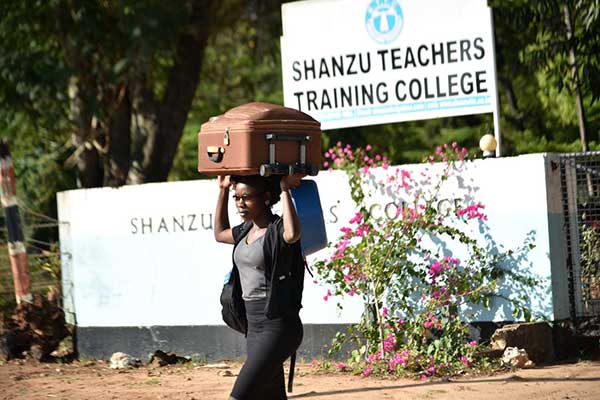
Principals of public Teachers Training Colleges (TTCs) will now not be able to admit students in their colleges without first being placed through Kenya Universities and Colleges Central Placement Services (KUCCPS).
This was revealed by Principal Secretary for Basic Education, Prof. Julius Bitok, through a circular sent to Principals of public Primary Teachers Training Colleges.
In the circular Bitok has directed the Principals to stop admission of students who have not been placed by KUCCPS as government moves to tame number of trained teachers churned out by colleges.
“This is to inform you that only the candidates placed by Kenya Universities and Colleges Central Placement Services (KUCCPS) will be admitted to the Public Teacher Training Colleges,” reads the circular by Prof. Bitok.
“The purpose of this circular therefore is to inform you to stop the admissions done at the college level (walk-ins),” he added.
This means students will have to apply for admission through KUCCPS which will then place them to various TTCs.
The move is part of government radical changes to address mass unemployment of teachers which currently stands at over 350,000.
KUCCPS released placement results where it has placed a total of 310,502 students to various programmes in universities and colleges which start this year.
A total of 10,800 students have been placed to sturdy Diploma in Primary Teacher Education (DPTE) while 836 have been placed under secondary teachers education.
Overwhelmed by number of unemployed teachers the Teachers Service Commission (TSC) had advised colleges against training of more primary school teachers.
Former TSC CEO Dr. Nancy Macharia while appearing before the National Assembly Constitutional Implementation Oversight Committee stated that the Commission had advised colleges to stop intakes as there is surplus of primary school teachers in payroll and the job market.
Macharia was reacting after the Karemba Muchangi led committee questioned why thousands of graduates remain jobless despite a high teacher shortage in several counties.
“After curriculum changes removed Standards 6, 7, and 8, we ended up with surplus teachers in some primary schools. We’ve advised against training more primary teachers, yet colleges continue.” explained Macharia.
The pioneer Diploma Primary Teacher Education (DPTE) students have now graduated after completing the three year Diploma course.
Following introduction of the Competency Based Curriculum (CBC), both PTE and ECDE courses were abolished.
Instead the Ministry of Education introduced Diploma courses as minimum teaching requirements in nursery and primary schools that are inline with the new curriculum.
In primary DPTE was introduced while Diploma in Early Childhood Teacher Education (DECTE) was introduced for nursery school teachers both taking three years.
However the two teaching courses will now be merged into one common course that will be referred to as Diploma in Teacher Education (DTE).
The ECDE teaching course DECTE and the primary school teaching course DPTE will now be a one course referred to as DTE.
The ECDE and primary trainee teachers will now study one course, DTE, which will take three years and requirement will only be C (plain) in KCSE.
Upon graduation the teachers will be registered by Teachers Service Commission (TSC) to handle Nursery and Primary schools (PP1 and PP2 and Grades 1 to 6 classes).
The teachers can seek employment by the county government or even TSC after receiving their TSC numbers.
The changes are part of the reforms proposed by the Presidential Working Party on Education Reforms (PWPER).
TSC and Ministry of Education are having ongoing talks to have ECDE teachers get employed by TSC.
TSC will place primary school teachers with DPTE at job group C1 upon employment as this is the entry grade for Diploma teachers.
A new scoresheet will be released by the Commission to address the new entrance.
Currently PTE teachers who upgraded to DPTE and were issued with UDPTE certificates are awarded 5 marks during recruitment.
However the efforts must be made to ensure all stakeholders are adequately sensitised on these changes.
Graduates of this new programme will be expected to competently teach pre-primary one and two, and grades one to six.
The entry requirements remain a minimum of C (plain) in the Kenya Certificate of Secondary Education examination.
Since early childhood education is the responsibility of county governments, the graduates of this new programme will have the option of either working under the county governments or the national government under the Teachers Service Commission.
According to the PWPER report, more reforms could be underway. The report observed that tutors have the responsibility of shaping teachers well-equipped with the requisite pedagogical knowledge and skills, however, there is no institution responsible for setting standards.
Hence the need for a national framework to provide standards. The report also noted that while micro-teaching allows teacher trainees to improve their teaching skills and gives them teaching experience, colleges continue to adopt varied structures and approaches, making the standardisation of practicum assessment difficult.
This calls for harmonisation. The proposed and on-going reforms in teacher education, if well implemented, will see colleges attract and develop effective teachers who will drive the changes envisaged in the new curriculum.